What to check
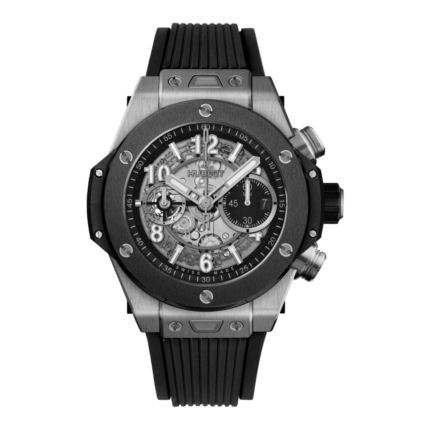
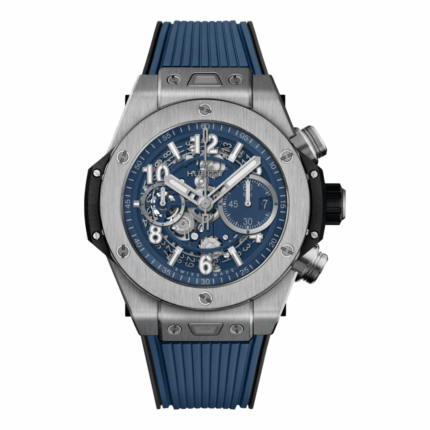
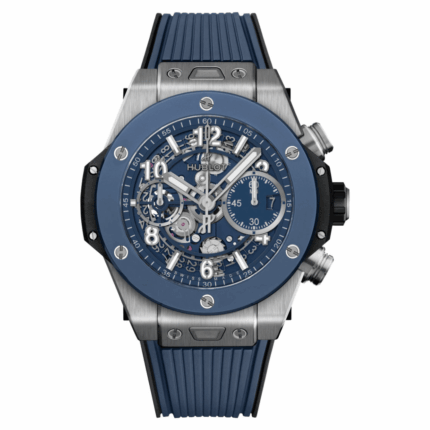
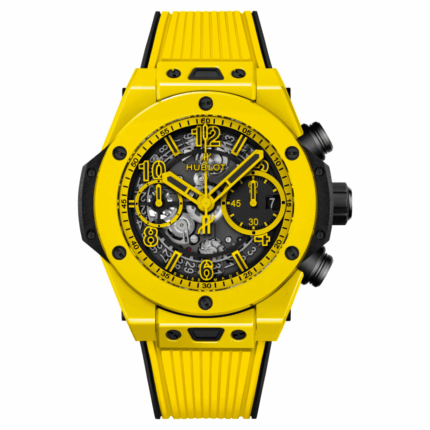
- H-screw alignment. All six should sit at the same angle. Randomly rotated screws are the single most common Big Bang fault and it is obvious in any straight-on photograph.
- Layer gaps. The joins between bezel, case and back should be tight and even all the way round.
- Rubber quality. Hublot’s strap rubber has a specific matte finish and a faint vanilla scent. Cheap rubber shines and smells of solvent.
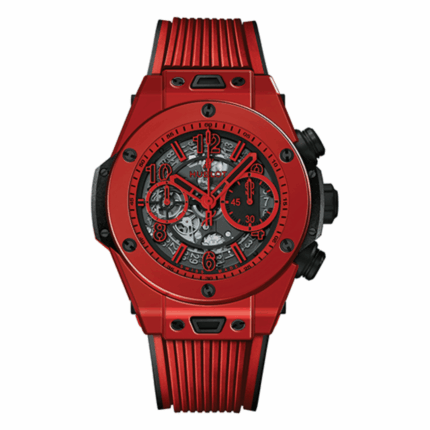
- Ceramic and carbon finish. Ceramic should be deep and even, carbon fibre should show a genuine woven or forged pattern rather than a printed film.
What we stock
Big Bang 44mm and 45mm in steel, ceramic, carbon and King Gold, Unico skeleton chronographs where the movement is the dial, Sang Bleu geometric variants, and diamond-set configurations. $973 to $1,205.
Who this suits
The Big Bang is a large, loud watch and it is meant to be. At 44mm plus a thick sandwich case it wears bigger than the number suggests. If your other watches are 40mm Rolexes, handle one before committing to it.
Before it ships
Each Big Bang spends 24 to 48 hours on a timegrapher. We check screw alignment and case-layer gaps by hand and photograph the case straight-on and from the side so both are verifiable before you approve.
Frequently asked questions
How much is a Big Bang super clone?
$973 to $1,205 depending on case material and whether the movement is skeletonised.
What gives away a bad Big Bang?
The six H-screws. On a correct build they all sit at the same angle. Randomly rotated screws are visible immediately.
Does the skeleton chronograph actually work?
On a super clone, yes. The chronograph functions and the openworked movement is genuinely visible through the dial.
Is 44mm too big?
It wears larger than 44mm because of the thick layered case. If you normally wear 40mm, size up cautiously.